Oven Repair
Wolf Oven Not Reaching Temperature: Reading the Gap Properly
Oven says 375°F, the rack thermometer says 320°F: what the gap means. Summit Cooking Appliance Service, (425) 272-6613.
Written by
Rafael Monteiro
Bench specialtyventilation and blowers
Part of Oven problems, the symptom series this guide sits in.
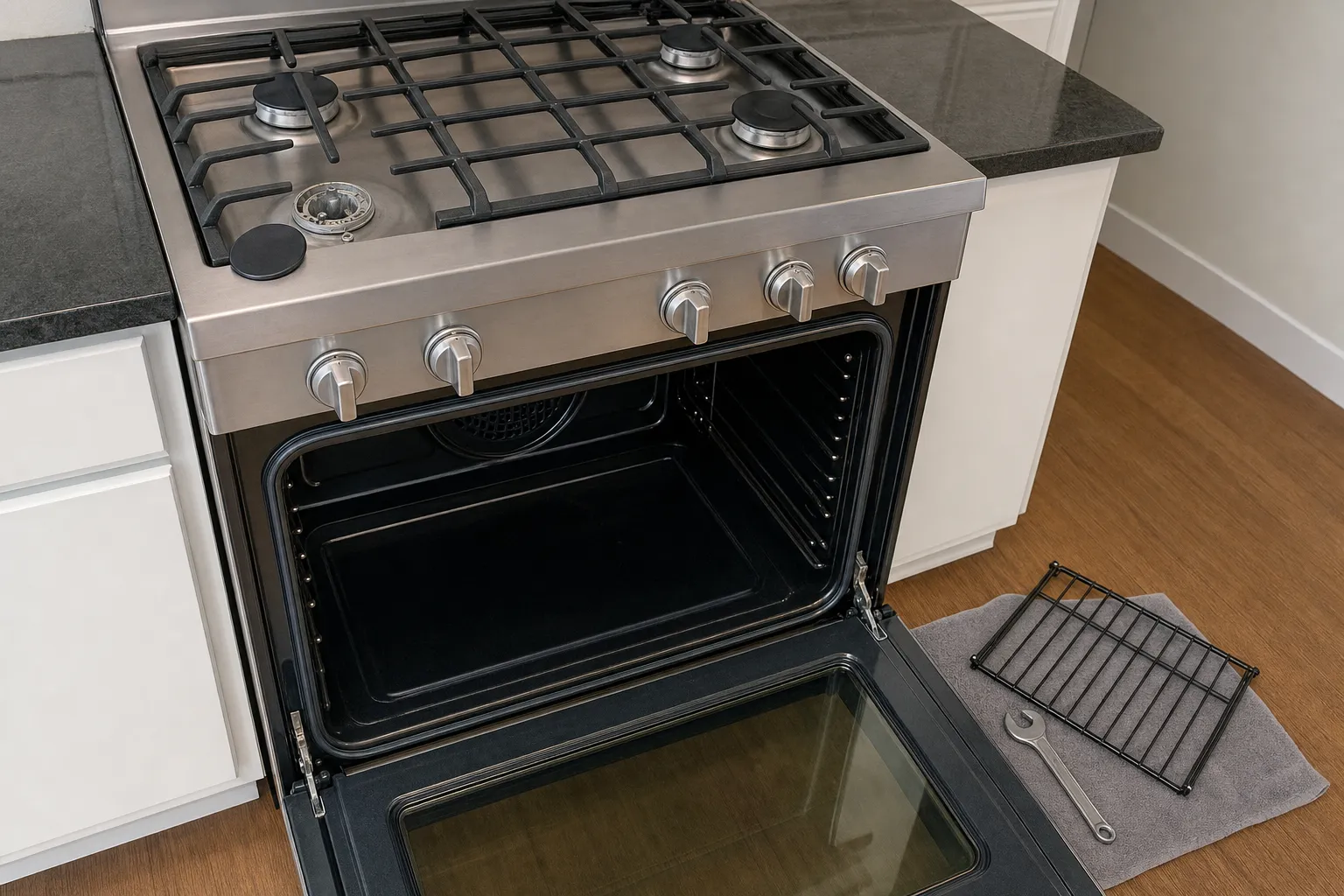
A call we hear often from Issaquah kitchens starts with the same sentence: the oven is set to 375°F, there is a thermometer sitting on the middle rack, and it is reading somewhere in the low 320s. The bread is pale, the roast takes forty minutes longer than the recipe says, and the obvious conclusion is that the oven is broken.
Sometimes it is. Often the gap is real but the cause is not what people assume, and once in a while the gap is not a gap at all — it is a measurement artefact. Working out which of those three you are looking at costs nothing and takes about half an hour, so it is worth doing before anybody is called out.
First, make sure the gap is real
An oven does not hold a temperature. It overshoots the setpoint, coasts back down past it, calls for heat again and overshoots again. Even on a healthy cavity that swing carries the air noticeably above and below the number on the display, and the average across the cycle is what actually cooks your food.
That matters because a thermometer read once, at whatever random moment you happened to open the door, catches the oven somewhere in that swing. A reading of 320°F could be the bottom of a perfectly normal cycle around 375°F.
So do it properly:
- Put a decent oven thermometer in the geometric middle of the cavity, not on the floor and not against a wall.
- Set 375°F and wait until the preheat tone has sounded, then wait another fifteen minutes. Preheat tones fire when the sensor is satisfied, not when the metal of the cavity has caught up.
- Read it every five minutes for half an hour without opening the door — look through the glass. Opening it dumps enough heat to invalidate the test.
- Average the readings.
If that average sits close to 375, the oven is heating as it should and the problem is somewhere else — usually rack position, pan colour, or a recipe written for a convection cavity being run conventionally. If the average sits well short, and a second test on another day agrees, you have a genuine fault.
Where a genuine shortfall comes from
Most common first, going by the Wolf cavities we open around Issaquah:
Calibration drift. The oven is heating correctly but its idea of 375 has wandered. This is the benign one. It shows up as a consistent offset — the same shortfall at every setpoint, not just the high ones — and it is put right by a calibration adjustment on a service visit rather than by a new part.
A failing heating element. Most built-in cavities run a bake element and a broil element, and on convection models a third element ringed around the fan. When one of them opens up, the oven still heats — just with a fraction of the power it should have. That is why the classic complaint is not “no heat” but “preheat takes forty minutes when it used to take twelve”. A visual check sometimes catches it: a blister, a split, or a bright scorched section on the sheath.
A drifting temperature sensor. The sensor is a resistance probe, and as it ages its resistance curve shifts. The control is doing exactly what it is told; it is just being told the wrong number. Sensor faults tend to produce erratic behaviour rather than a clean offset — fine one day, badly out the next.
A tired door seal. The least glamorous cause and a surprisingly common one. A gasket that has gone hard and flat on one side lets a steady draught of cool air in and hot air out. You will often feel it as warm air across the top edge of the door, and it usually comes with uneven browning as a companion symptom.
On an all-gas range there is a fifth: an oven burner that has grown slow to light. Every pause before the flame catches is time the cavity spends without heat, and the signature is a long wait between the burner being called and the whoomph of ignition.
What you can check yourself
Two of these you can genuinely narrow down without tools.
Look at the elements while the oven preheats. With the cavity empty, set a high temperature and watch. Any element you can see should glow evenly along its full length; on many ovens the bake element is hidden below the floor, so the broil element across the top is the one to watch. A section that stays dull, or an element that never glows at all, has told you most of what you need to know.
Check the door. Close it on a sheet of paper and pull. Do that at the top corners, the middle and the bottom of both sides. Anywhere it comes away without being gripped, that stretch of gasket has stopped doing its job. While you are there, push the door gently at the top — if it moves against the frame or sits proud on one side, the hinges have lost tension, which does the same thing.
What is not worth doing: asking for a calibration adjustment so the display matches the thermometer, then forgetting about it. If the cause is a failing element or a drifting sensor, the offset masks the problem for a few weeks and then you are back where you started, with less information than before.
When it is worth calling someone
Call if a properly averaged test still shows a clear shortfall, if it is getting worse rather than sitting still, if the preheat time has changed noticeably, or if an element is visibly damaged. Also call if the display shows a message you do not recognise — write down exactly what it says before you cut power, because that wording is one of the quickest clues either of us has.
Elements, sensors, gaskets and igniters all wear with use on a built-in Wolf oven, and each is a part that can be replaced on its own. That is the argument for repairing rather than replacing: one worn part does not condemn the oven around it.
Have the model and serial ready when you ring. On a Wolf range, open the oven door and look along the lower edge of the control panel, toward its right-hand end; on a wall oven the tag is by the control panel or the lower trim depending on the series, again with the door open. Those numbers decide which revision of the part is ordered, and they are the difference between a one-visit repair and a two-visit one.
Follow-up questions
Can I just recalibrate the oven myself and carry on?
Wolf's own answer is that recalibrating an oven is possible but rarely needed, and that it is service work rather than an owner setting. It also only suits a shortfall that is small and steady. A gap that grows week by week is a part on its way out, and an adjustment would simply hide it until it fails.
Is a single thermometer reading enough to prove there is a fault?
No. An oven cycles around its setpoint, so any single reading catches it somewhere in that swing. Take readings every five minutes across half an hour once the oven has fully preheated, look through the glass rather than opening the door, and work from the average.
The oven still gets hot, just slowly. Is it safe to keep using?
Generally yes on an electric cavity, though results will be inconsistent from one bake to the next. On a gas oven, have slow or hesitant lighting looked at sooner rather than later: a burner that takes its time to catch is not one to keep relying on, and the cause is worth finding before it gets worse.